Pedaling for hours and days and miles give you a chance to contemplate the details of life. Sometimes they’re important. Sometimes they’re not.
Enjoying the Tour:
You Are a Curiosity
Someone pedaling a bike loaded with panniers full of travel gear gets people’s attention and piques their interest. Don’t be shy. Take advantage. They want to hear your stories, tell you theirs, and offer advice. Pedal up and say hello. It will make the ride a lot more interesting.
Water-Proof Matters
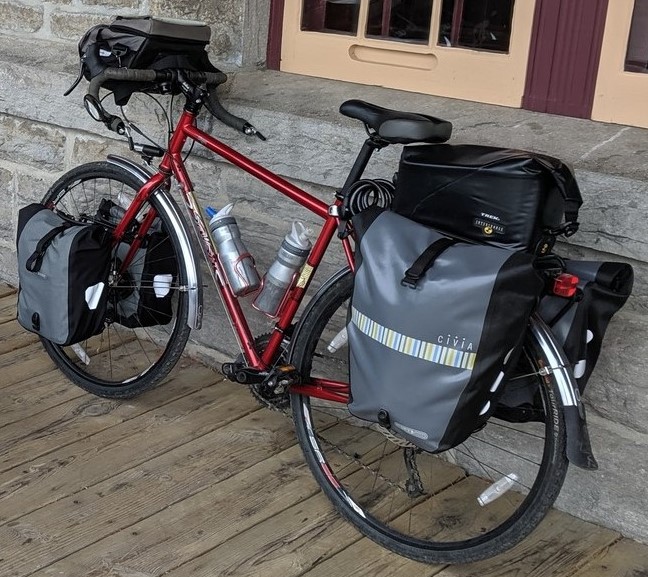
Wet gear is useless. Get waterproof bags and test them before the tour, just to make sure…even if the forecast is for sunny skies. Rain happens.
Getting ready for an extended tour can be both exciting and stressful. You’re about to embark on a big, challenging adventure and don’t want to load your bike down with too much weight, but you also don’t want to be left stranded on the side of the road or suffer at a camp site because you forgot to pack something important.
I just finished an 8-day, 400-mile trek around Quebec and took the opportunity to document my current touring gear collection, which has been refined over a decade of trips.
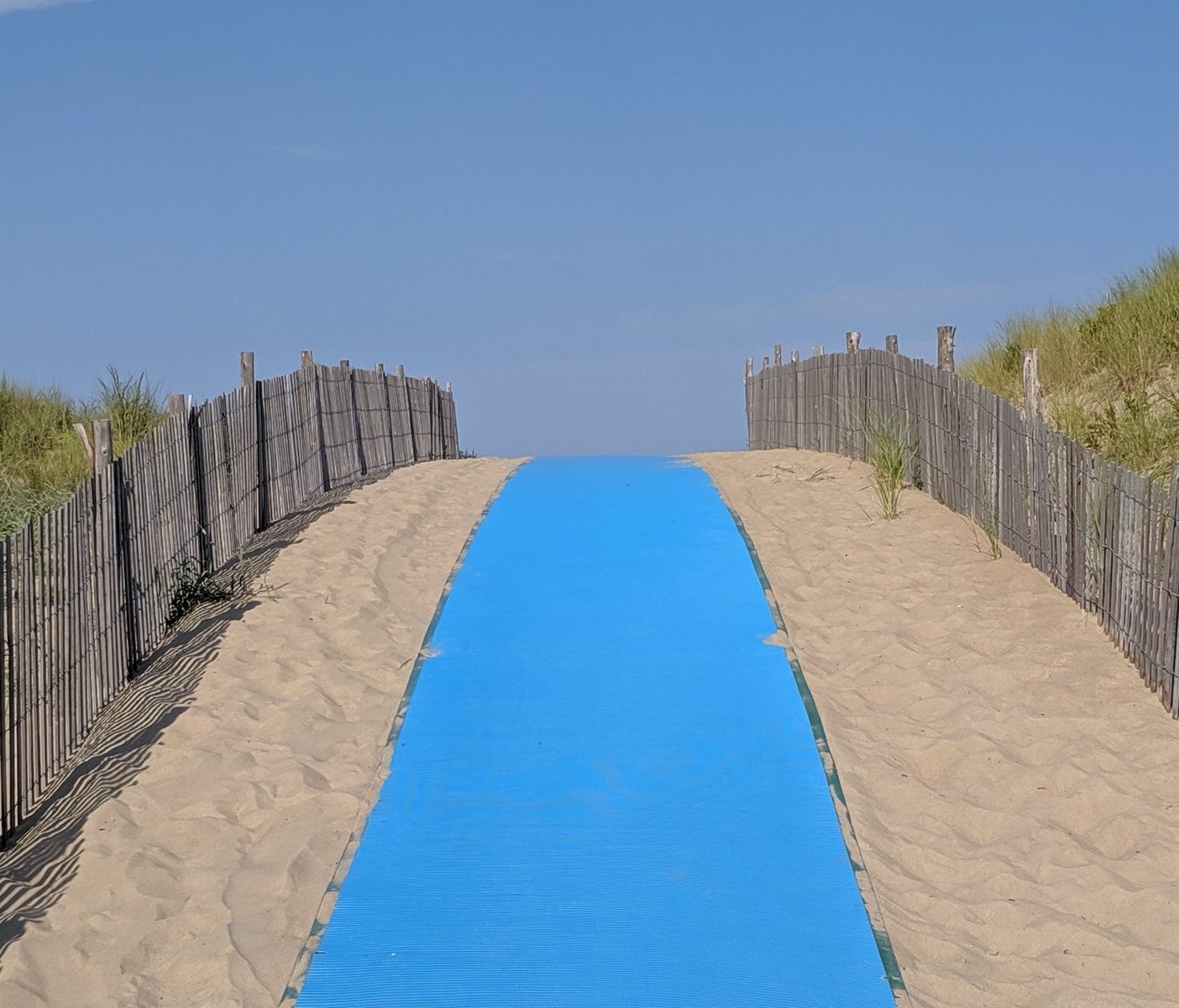
The Delaware shore has a cluster of popular beach towns that are great for cycling. Moderate traffic, flat terrain, interesting scenery, and a few nice trails make it well worth loading your bike on the car for some exploration.
I recently spent a long afternoon pedaling through three towns, past suburban developments, marshlands, forests, dunes, boardwalks, tourist-filled beaches, and the captivating Cape Henlopen State Park.
I’ve visited Oregon many times over the years but, like most people, have stuck to the wet, green 100-mile strip along the Pacific. The only exception was a weekend jaunt to the Bend/Sisters area nearly a decade ago that gave me a taste of the dramatically different landscape that lies in the high desert east of the Cascade Range.
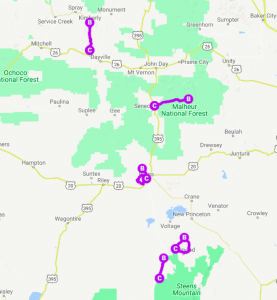
When I returned this year to visit my good friends Steve and Laura in Portland, we agreed it was time to get out and see some of the natural wonders in the east, and to do a lot of it by bike. The distances are long and our time was limited, so we planned a mix of driving and day rides. We opted for two nights each in John Day, Burns, and Frenchglen. I scoured maps and local websites to identify loop or out-and-back rides that would mix great scenery with minimal traffic, moderate distances (25-40 miles), reasonable climbing (2500 feet or less) and decent surfaces (asphalt or well-used gravel). We decided on five rides:
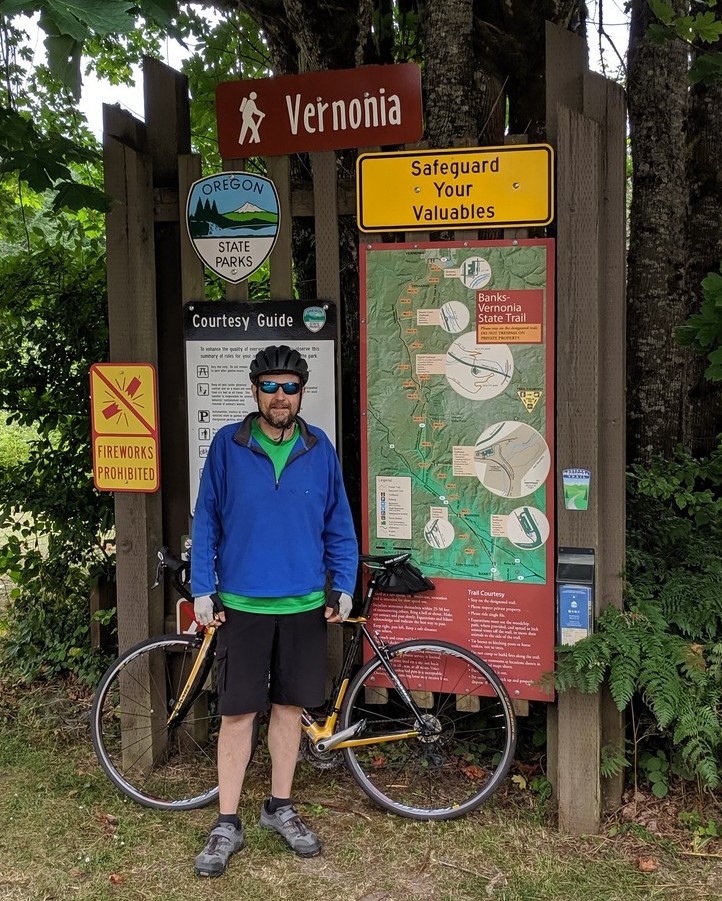
If you’re looking for a day ride that’s a bit more strenuous than the Springwater Corridor or Sauvie Island, but want to avoid the stress of traffic-heavy roads, check out the Banks-Vernonia Rail Trail. It offers nice towns, great scenery, some elevation changes, and even multiple options for camping.
If you’re looking for a flat, easy, relaxed ride starting downtown or in the southeast quadrant of Portland, the Springwater Corridor is your choice. It’s a rail trail that starts along the Willamette River near the southern end of the Eastbank Esplanade, heads south to Sellwood, then turns east along Johnson Creek and past Powell Butte to Gresham and Boring.
Most of the trail is off-road and the few road transitions are bike friendly.
Portland is a one of the most bike friendly cities in the US, with bike lanes everywhere, thousands of bike commuters, local bike shops in most neighborhoods, and lots of organized events. This includes the annual Naked Bike Ride, which flashed through town while I was there in late June and early July. BikePortland.org has a useful calendar.
I have some great friends who live in the lively Hawthorne neighborhood and are kind enough to let me stay in their basement guest suite during extended summer visits when I can enjoy their company and escape the east coast humidity. This year, we ventured out for a week-long trip to do some cycling in the high desert of eastern Oregon. I also took advantage of the opportunity to do some day rides in and around the city. Each was flexible in length, with options up to 40+ miles and offered great scenery with minimal traffic concerns.
Just 11 miles from downtown Portland, as the waters of the Columbia and Willamette rivers flow from their confluence towards the Pacific Ocean, they encircle a bucolic piece of farm and park land call Sauvie Island. It’s about a 60 minute ride (or 20 minute drive) from downtown Portland but feels like a world away, with winding country lanes, quaint farms, lakes, beaches, a lighthouse, and wildlife refuge areas.
My friend Steve and I have been traveling together for about two decades. We met when I was running a home beer and wine supply store in Austin, TX and he came in wanting to get started brewing. Unsurprisingly, much of our travel has revolved around places with good beer and wine, like Belgium and Bordeaux, Oregon and Oktoberfest.
In 2016, things changed. He was settled into a relationship with Laura, who owned more bikes than me and had been touring for decades. We started talking about combining our annual trip with some bike touring.
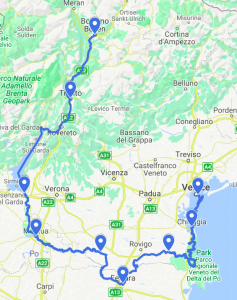
I had never done an organized tour, and it sounded intriguing. We agreed it should be somewhere in Europe. None of us had spent much time in Italy, so we focused on tours there, eventually settling on a bike and barge tour of the northern part of the country. It would follow mostly flat terrain, starting in Bolzano, near the Austrian border. The first few days would follow the Adige River to Lake Garda, then the Mincio River to Mantova. From there, a canal barge would follow us through small towns in the Po River Delta, eventually reaching Venice. The Bolzano-to-Mantova section would be self-guided with hotel stays. The rest would be guided with lodging and dinners on the barge. The tour price was just over $2000 per person, including bike rental, lodging, luggage transfer, and meals on the barge. The total riding distance would be about 250 miles.
How much stuff do you really need to carry on your bike? And how do you carry it?
Hmm. That’s a “loaded” question.
It depends. Are you commuting? Do you need to carry a computer? Clothes? Are you touring? Doing a multiday ride? An all day ride with changing weather?
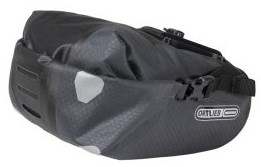
The answers to many of those questions could easily lead to the conclusion that the best solution is to install a rear rack and have the option of a rack trunk or panniers. Most of my bikes are configured that way. I even have a guitar with a removable neck and a case that’s fitted with Ortlieb hardware so it can be easily secured to a rack.
But what if all you are doing is hopping on for a ride after work. It feels good to go fast. It feels good to have a bike that’s light and nimble. That rack is heavy, and so are the bags. What about the drag. you paid a lot of money for a bike with a carbon fork and lightweight components, and now your gonna load it down with a bunch of heavy luggage? Not a chance.
I just built up a bike with the sole purpose of being my daily ride, the one I take out for a spin up the Schuylkill River Trail or out to meet friends for dinner. It’s not going for overnight trips loaded with camping gear. It’s not going to hop downed trees on single track trails. But it’s going to see both pavement and gravel. It’s going to see weather changes from morning to afternoon or afternoon to evening. It needs to be able to carry some stuff.